The Calcium Problem Nobody Talks About
Vitamin D3 gets all the press. And for good reason — the majority of Americans are deficient in it, and its effects span bone density, immune function, insulin sensitivity, mood regulation, and cancer prevention. But vitamin D3 has a side effect that almost no one mentions: it dramatically increases calcium absorption. And calcium that is absorbed but not properly directed is not neutral. It goes somewhere. Often, it goes somewhere you don’t want it to go.
Unguided calcium — calcium mobilized by D3 but not directed by K2 — tends to deposit in soft tissues and arterial walls. This is arterial calcification. It contributes directly to arterial stiffness, elevated blood pressure, and cardiovascular disease risk. Studies have shown that taking high-dose D3 without K2 can actually worsen cardiovascular markers over time, even while improving bone health measurements.
K2 is the traffic cop. It activates two critical proteins that D3 cannot activate alone: osteocalcin, which binds calcium into the bone matrix, and matrix GLA protein (MGP), which actively inhibits calcium from depositing in arterial walls and soft tissues. Without K2, these proteins sit inactive. With K2, calcium goes where it belongs.
“Taking D3 without K2 is like fertilizing a garden with no irrigation. The nutrients are there. Where they end up is another question entirely.”
What D3 Actually Does
Vitamin D3 (cholecalciferol) is technically a hormone precursor, not a vitamin. It is produced by your skin in response to UVB sunlight exposure and then converted by the liver and kidneys into its active form, calcitriol. Calcitriol functions as a steroid hormone, binding to vitamin D receptors (VDRs) found in virtually every tissue in the body — including the pancreas, immune cells, brain, and cardiovascular system.
In the context of diabetes and metabolic health, D3 is particularly important for two reasons. First, vitamin D receptors are present in beta cells — the insulin-producing cells of the pancreas. Low D3 status is consistently associated with impaired insulin secretion and increased insulin resistance. Multiple studies show that vitamin D3 repletion in deficient individuals improves insulin sensitivity measurably within 12 weeks. Second, D3 is a potent immune modulator. Chronic low-grade inflammation — the kind that drives T2D progression — is significantly worsened by D3 deficiency.
The threshold for true D3 sufficiency is higher than most people realize. Most physicians consider 20 ng/mL adequate, but the functional medicine literature — and most of the longevity research — targets 50–70 ng/mL as the optimal range. Blood testing (25-OH vitamin D) is straightforward and worth doing at least annually.
What K2 Actually Does
Vitamin K2 is not the same as vitamin K1. K1 (phylloquinone) is found in leafy greens and primarily supports blood clotting. K2 (menaquinone) is found in fermented foods, certain animal products, and almost nowhere else in the Western diet. It is the form that activates osteocalcin and MGP.
There are multiple forms of K2. MK-4 is short-acting and requires multiple daily doses. MK-7 (derived from natto, a fermented Japanese soybean product) has a half-life of 72 hours, meaning a single daily dose maintains consistent blood levels. The research on bone density is most robust for MK-7. A three-year randomized controlled trial in 244 postmenopausal women found that 180mcg of MK-7 daily significantly slowed age-related decline in lumbar spine and femoral neck bone mineral density compared to placebo — and measurably improved bone strength indices.
For arterial health, the evidence is equally compelling. The Rotterdam Study — a large-scale observational study — found that individuals with the highest dietary K2 intake had a 57% lower risk of dying from cardiovascular disease and a 52% lower risk of severe arterial calcification. K1 intake showed no such association. This is a K2-specific effect, driven by MGP activation.
Vitamin D Deficiency and Diabetes
The link between vitamin D deficiency and type 2 diabetes is one of the most replicated findings in metabolic research. Observational studies show that people with the lowest 25-OH vitamin D levels have roughly double the risk of developing T2D compared to those with sufficient levels. The mechanisms are multiple: impaired insulin secretion from beta cells, increased insulin resistance in peripheral tissues, systemic inflammation driven by immune dysregulation, and impaired calcium signaling in muscle cells that affects glucose uptake.
A 2023 meta-analysis of RCTs found that vitamin D3 supplementation in deficient individuals with prediabetes reduced progression to full T2D by approximately 15%, with the benefit concentrated in those who achieved blood levels above 40 ng/mL. If you have diabetes or prediabetes and you have never tested your 25-OH vitamin D level, that is the first lab to order.
Most people taking D3 are not taking enough of it. And almost none of them are taking K2 alongside it. Both problems have the same fix.
How to Take It
D3 Dose: The standard supplemental dose of 1,000–2,000 IU is generally inadequate for someone who is deficient. Most people who are starting from a deficient baseline need 4,000–5,000 IU daily to reach optimal blood levels. Get your 25-OH vitamin D tested 90 days after starting supplementation. Adjust based on results. Target 50–70 ng/mL.
K2 Dose: 90–180mcg of MK-7 daily. The MK-7 form has the most clinical evidence and the best pharmacokinetics for once-daily dosing. Look for it specifically on the label.
Timing: Both D3 and K2 are fat-soluble. Take with your largest meal of the day. If you take blood thinners (warfarin/Coumadin), talk to your physician before adding K2 — it can affect INR levels.
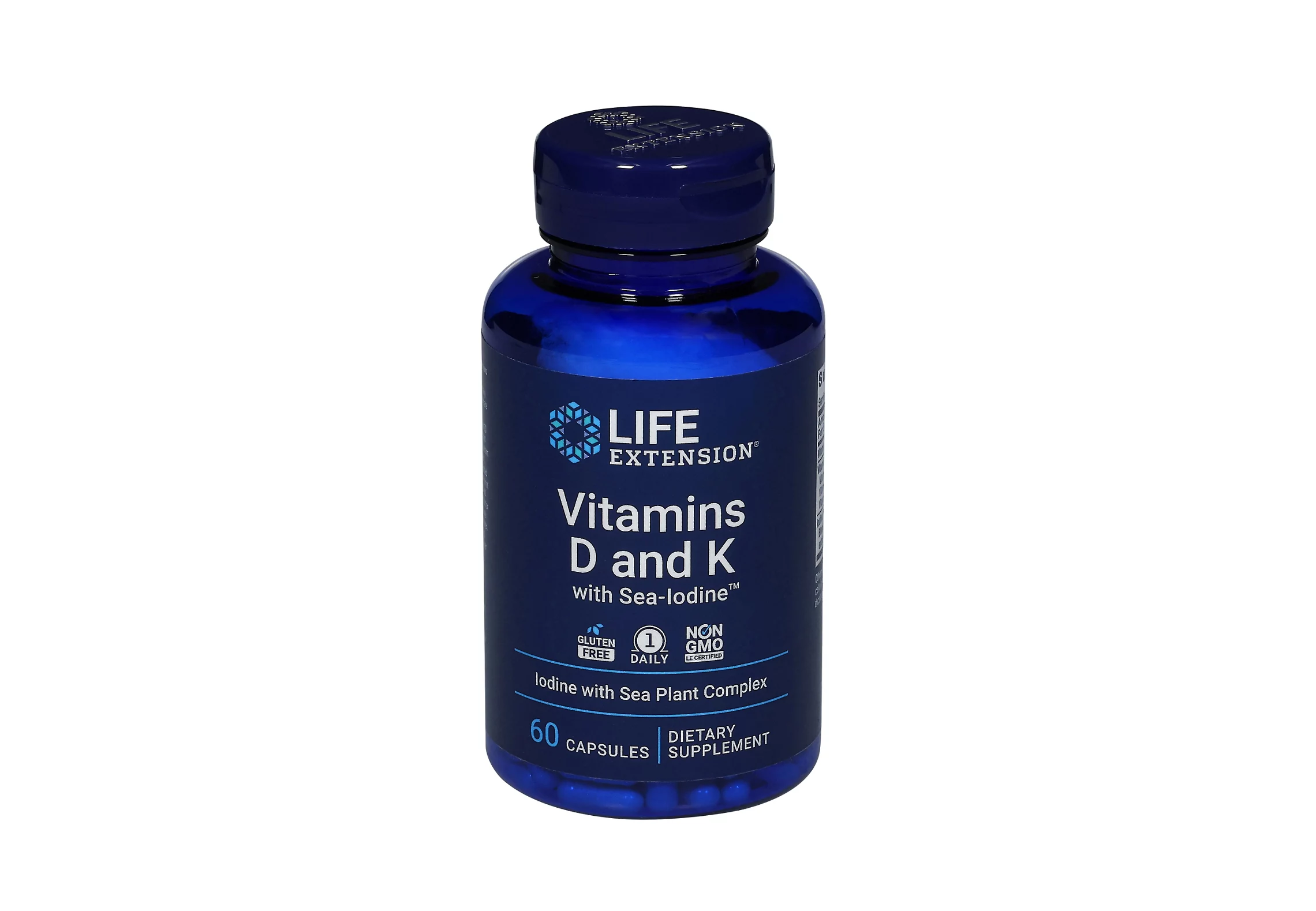
Combined products: D3+K2 in a single softgel is widely available and is generally the most convenient approach. The Life Extension D & K formula is one of the better-researched options, using MK-7 at a meaningful dose alongside D3.
This page is for informational purposes only and is not medical advice. Consult your physician before making changes to your medications or supplement regimen. K2 may interact with anticoagulant medications.
Sources
- Knapen, M.H. et al. (2013). Three-year low-dose menaquinone-7 supplementation helps decrease bone loss in healthy postmenopausal women. Osteoporosis International, 24(9), 2499–2507.
- Geleijnse, J.M. et al. (2004). Dietary intake of menaquinone is associated with a reduced risk of coronary heart disease (Rotterdam Study). Journal of Nutrition, 134(11), 3100–3105.
- Pittas, A.G. et al. (2023). Vitamin D and Risk for Type 2 Diabetes in People With Prediabetes (D-HEALTH). Annals of Internal Medicine.
- Rupa Health (2024). The science behind taking vitamin D and K together. rupahealth.com
- Instalab (2024). Can Vitamin D and K2 together better prevent arterial calcification? instalab.com