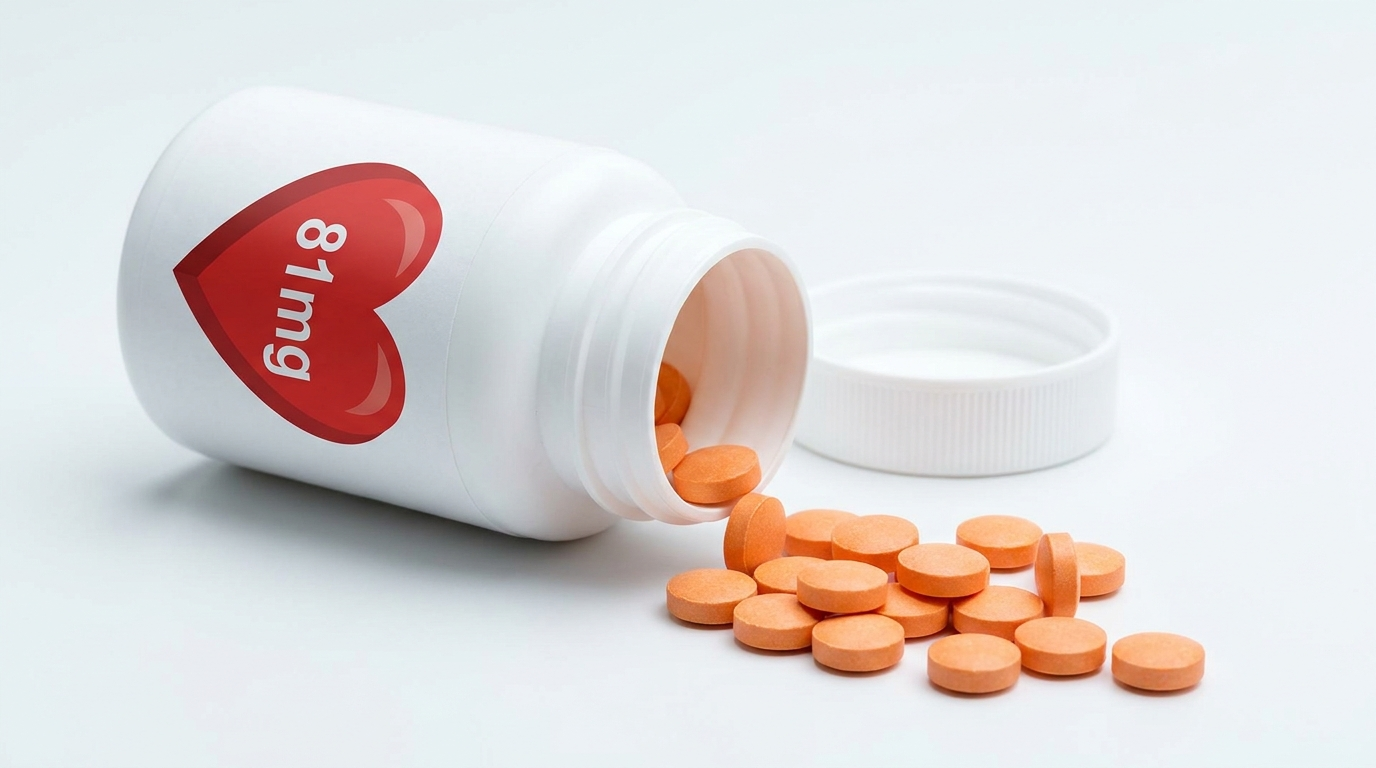
The 81mg Question
For decades, daily low-dose aspirin (81mg) was one of the most widely recommended preventive measures in medicine. Millions of people over 50 took it every day on their doctor’s advice. Then the guidelines changed. Between 2019 and 2022, the major cardiology societies revised their recommendations away from routine aspirin use for primary prevention (preventing a first heart attack or stroke in people with no prior event), citing a risk-benefit calculation that no longer favored it for most people. The updated 2024 USPSTF guidance reflects this shift.
The reason for the change is not that aspirin stopped working. It is that the bleeding risk — particularly gastrointestinal bleeding and hemorrhagic stroke — has proven more significant than earlier trials captured. A 2019 meta-analysis of primary prevention studies involving more than 164,000 participants found that aspirin reduced major cardiovascular events by 11% but increased the risk of major bleeding by 43%. When the cardiovascular event rate is low (as it is in the general healthy population with no prior heart attack), the bleeds begin to outnumber the events prevented.
The T2D Case Is Different
Here is where the diabetes context matters. People with type 2 diabetes have two to four times the baseline cardiovascular risk of the general population. Higher risk means more cardiovascular events available to be prevented — which shifts the risk-benefit calculation back toward benefit. The same 81mg aspirin that may not help a healthy 55-year-old with no risk factors may meaningfully reduce events in a 55-year-old with T2D, hypertension, and a family history of heart disease.
A 2025 study presented at the American Heart Association’s Scientific Sessions found that people with type 2 diabetes at elevated cardiovascular risk who took low-dose aspirin were significantly less likely to experience a major cardiovascular event (heart attack, stroke, or cardiovascular death) than those who did not. The benefit was most pronounced in adults over 60.
A meta-analysis of low-dose aspirin trials specifically in people with diabetes found a 9% reduction in major adverse cardiovascular events, with the risk reduction largest in people with the highest baseline cardiovascular risk. The bleeding risk in these trials was also higher in the aspirin group, but in the high-risk T2D population, the events prevented exceeded the bleeds caused.
“The guidelines moved against routine aspirin for the general population. For people with T2D and elevated cardiovascular risk, the conversation is different. Higher baseline risk means more events available to prevent.”
How Aspirin Works
Aspirin irreversibly inhibits COX-1 enzymes in platelets, preventing the production of thromboxane A2 — the signaling molecule that causes platelets to aggregate and clump together. Blood clots that trigger heart attacks and strokes form when platelets clump at sites of arterial plaque rupture. By reducing platelet clumping, aspirin reduces the likelihood that a plaque rupture turns into a complete arterial blockage.
The 81mg dose specifically targets the platelet COX-1 enzyme while largely sparing the COX-1 in the stomach lining (which produces protective prostaglandins). Higher doses of aspirin (325mg+) inhibit stomach lining COX-1 as well, increasing GI irritation and bleeding risk. Low-dose aspirin retains the antiplatelet effect with somewhat less GI impact — though risk is not eliminated.
Aspirin also has anti-inflammatory properties at higher doses. At 81mg, the anti-inflammatory effect is minimal — the value is almost entirely in the antiplatelet mechanism.
The Conversation to Have with Your Doctor
This is the page on this site that most directly requires a physician conversation before acting on. Unlike supplements where the worst-case scenario is limited efficacy, aspirin’s bleeding risk is real and individual-specific. The right decision depends on your calculated cardiovascular risk score, your history of GI problems (ulcer, bleeding, GERD), whether you are on any anticoagulants, your age, and your blood pressure control. Most major guidelines agree that low-dose aspirin is appropriate for secondary prevention — if you have already had a heart attack or stroke — without exception. The debate is in primary prevention for high-risk populations like T2D.
Ask your physician specifically: “Given my cardiovascular risk profile with diabetes, does low-dose aspirin make sense for me?” That is the right framing. The answer may well be yes. It just should not be a unilateral decision made by reading a supplement page on the internet.
If You Do Take It
Dose: 81mg (one “baby aspirin”) daily. This is the standard antiplatelet dose. Higher doses do not improve cardiovascular protection and increase bleeding risk.
Timing: Evening aspirin may have slightly better antiplatelet effect in some studies due to platelet turnover patterns overnight. Morning is equally common and fine. What matters most is consistency — missing doses interrupts platelet inhibition since new platelets are constantly being produced.
With food or antacid: Taking aspirin with food or a small amount of antacid reduces gastric irritation. Enteric-coated aspirin is widely used but evidence that it reduces GI bleeding risk compared to uncoated is actually mixed.
Do not stop abruptly if you have been on aspirin for secondary prevention. Sudden discontinuation can trigger a rebound increase in platelet aggregation. Taper with physician guidance.
This page is for informational purposes only and is not medical advice. Consult your physician before starting or stopping aspirin therapy, particularly if you are managing cardiovascular risk.
Sources
- Bowman, L. et al. (2018). Effects of aspirin for primary prevention in persons with diabetes mellitus (ASCEND). NEJM, 379(16).
- USPSTF (2022). Aspirin use to prevent cardiovascular disease: preventive medication. uspreventiveservicestaskforce.org
- American Heart Association Scientific Sessions (2025). Low-dose aspirin linked to lower cardiovascular event risk for adults with type 2 diabetes. newsroom.heart.org
- PMC (2019). Low-dose aspirin for primary prevention of CVD in diabetic individuals: a meta-analysis of RCTs. PMC6572181.
- Medi-Cal Rx (2024). Aspirin for primary prevention of cardiovascular disease. medi-calrx.dhcs.ca.gov